
India's economy is in much better shape to weather tighter U.S. monetary policy.

In the forward market, the premium for dollar moved up on fresh paying pressure corporates.
In the previous reporting week, the reserves had surged by $954.6 million to $294.36 billion.

Foreign exchange reserves jumped $1.17 billion to touch a new record high of $355.46 billion.

The government has hiked gold import duty to 15 per cent from 10.75 per cent to check the current account deficit (CAD) and rising import of the yellow metal. The duty changes came into effect on June 30. Earlier, the basic customs duty on gold was 7.5 per cent, now it will be 12.5 per cent.


After selling dollars for the past few months, the Reserve Bank of India (RBI) may take a hands-off approach before its annual account closing by not trying to prop up the rupee as geopolitical tensions show signs of stabilising with global crude oil prices easing from its $140 peak. The central bank was a net buyer of dollars between April and September, and then turned a net seller in the following months, the data released by the RBI showed. The RBI continued to be a net buyer of $36.6 billion in this fiscal year - between April and January. In 2020-21, it purchased $68 billion on a net basis.

The rupee depreciated 6 paise to 77.50 against the US dollar in the opening trade on Wednesday as a surging American currency in the overseas markets and persistent foreign fund outflows weighed on investor sentiment. Besides, rising global crude prices impacted the domestic unit, forex traders said. However, a higher opening in the domestic equity market restricted the rupee's fall, they added.

At the Interbank Foreign Exchange (Forex) market, the rupee resumed sharply higher at 53.80 a dollar compared to last Friday's close of 54.30.

'A time-wise, as well as price correction, so that the market can absorb the gains made over the past 17 months.'

Indian rupee is likely to test 76-76.50 levels as a relatively strong greenback, boiling crude prices and COVID headwinds deepen the depreciation bias for the domestic currency, according to experts. One of the significantly-hit Asian currency in recent months amid uncertain economic times, rupee is expected to see a consolidation in the vicinity of the current level before being pulled towards the depreciation bias. While the equity market has been surging with occasional blips, the rupee has mostly been weak against the US dollar in recent months.

Fresh demand for the American unit from importers put pressure on the rupee.
A weak dollar in overseas market in view of the Federal Reserve's cautious stance on interest rate strengthened the rupee value.

The Reserve Bank will go for a "dovish pause" at Wednesday's policy review announcement amid developments such as a rise in inflation, government maintaining the inflation target band and a likely impact on growth due to local lockdowns on rising COVID-19 infections, analysts said on Monday. Economists at American brokerage Bofa Securities said price stability, growth and financial stability will become the prime focus areas for the central bank going forward. "The RBI MPC (Monetary Policy Committee) should deliver another dovish pause on Wednesday," it said. The policy announcement, the first for the fiscal, will come days after the government maintained the RBI's target to ensure inflation to be within 2-6 per cent band for five more years.

Forex dealers said besides robust month-end demand for the American currency from oil importers, dollar's strength against its rival currencies on expectations of rising interest rates amid lingering Sino-US trade tensions, weighed on the domestic currency.

Overall forex market sentiment suffered a sudden reversal of fortune contrary to expectation largely moving in line with local equities, reversing all early strong gains.
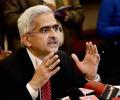
Reserve Bank Governor Shaktikanta Das on Monday said despite the latest headwinds arising from the Jackson Hole summit leading to extreme volatility, our banking system and financial markets are strong enough to withstand such pressures. Taking the markets by surprise, US Fed chair Jerome Powell had told the annual Jackson Hole summit of central bankers and economists last week that he would have to keep raising federal fund rates to tame inflation, which remains the biggest challenge to the world's largest economy. He also warned of the pains that such monetary policy actions would create on growth and jobs.
Since the start of the year, the RBI has had to contend with rising inflation and increased liquidity in the financial system causing it to raise CRR and repo rate to reign in the excess money.
The US dollar surged to fresh one-year high after the Fed chief's testimony to the US Senate on Wednesday bolstered the expectations of interest rate hikes, though gradually.

'This is a good time to restructure your portfolio because the sectors and stocks that performed in the last bull market may not perform as much now.'

FPIs, which are holding large exposures in Indian debt, could also be expected to book some capital gains as yields slide down
The financial market gave a thumbs up to Reserve Bank of India's annual credit policy, which pushed up the benchmark Sensex higher by over 225 points and lifted the Rupee to over a nine-year high.

HDFC Bank was the top loser in the Sensex pack, shedding over 2 per cent, followed by Kotak Bank, Bajaj Finserv, Maruti, Titan, SBI, HUL, HDFC and Tata Steel. On the other hand, Bharti Airtel, M&M, NTPC, Tech Mahindra, Sun Pharma and PowerGrid were among the gainers.

The Indian currency had appreciated by a whopping 85 paise in three-day surge

The dollar index, which tracks the world's reserve currency against a basket of its peers, is down 0.16 per cent at 97.58.

The finance ministry on Tuesday cited "green shoots" of recovery in agriculture, manufacturing and services sectors, and said the prompt policy measures taken by the government and RBI have helped reinvigorate the economy with minimal damage. Stating that the agricultural sector remains the foundation of the Indian economy, the ministry said that a normal monsoon, as has been forecast, should support the rebooting of economy.

Dealers attributed the rupee's fall to increased demand for the US currency from importers.
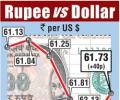
Forex dealers said besides a lower opening in the domestic equity market on fears of a rate hike by the Reserve Bank, higher demand for the American currency from importers put pressure on the rupee but dollar's weakness against other currencies overseas, capped the fall.

Rupee ends day at 61.91 against the US dollar.
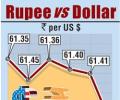
The rupee had ended almost flat at 61.41 against the Greenback in the previous session on Wednesday on alternate bouts of buying and selling.

The NSE index Nifty ended above the 10,500-mark.

The local currency had gained 10 paise to close at 63.51.

Extending its losing streak for the fourth straight day, the rupee weakened by five paise to 61.01 against the US dollar in early trade today at the Interbank Foreign Exchange market on high demand for the American currency from importers.
After three sessions of weakness, the rupee strengthened by 50 paise against the dollar.

The rupee added another 8 paise to end at 61.23 against the dollar, the highest level in more than two weeks, as the US currency traded stable ahead of the outcome of Federal Reserve's meeting today and as domestic shares surged to a record.
This is the highest closing level since May 11, 2016 when the rupee had finished at 66.56

The rupee weakened by 27 paise to trade at six-week low of 60.45 against the US dollar in early trade today at the Interbank Foreign Exchange market on high demand for the American currency from importers.

India's foreign exchange reserves declined by a whopping $4.343 billion to $367.646 billion.

Concerns related to capital outflows in the aftermath of the first US interest rate hike in nearly a decade predominantly weighed on the rupee trade.

Travel companies and agencies are offering early bird discounts going up to 40 per cent. Priyadarshini Maji reports
